
 English English
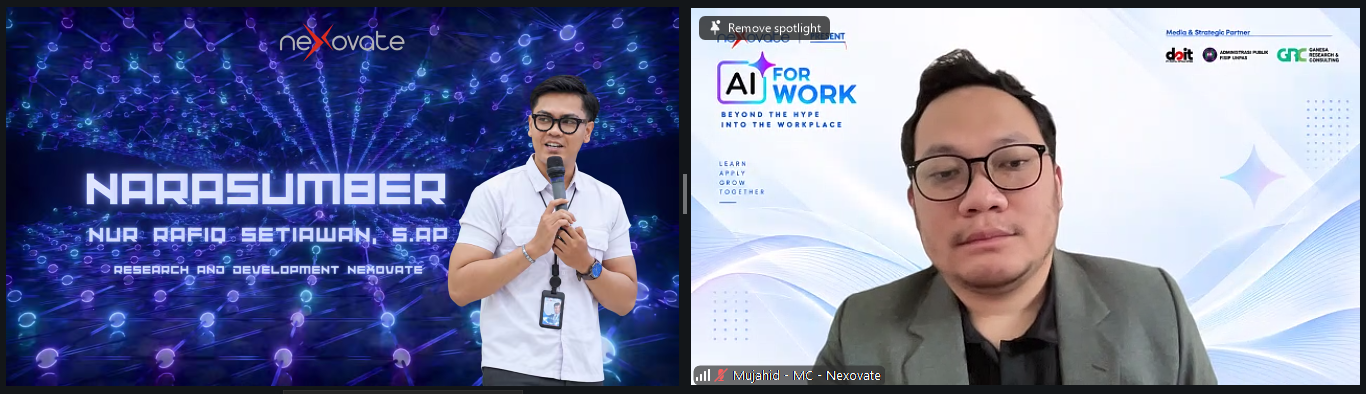
The rise of **Generative AI** has transformed how professionals search for information, draft documents, conduct analyses, and produce various work outputs. However, the widespread adoption of AI also raises increasingly critical questions: **when should AI be used, to what extent can its results be trusted, and at what point must humans retain control?** To address these needs, Nexovate presents the program **“AI for Work: Beyond the Hype, Into the Workplace”**—an *online public training* course designed to bridge the gap between AI concepts and everyday work activities.
This program is structured into three batches held on September 12, 19, and 26, 2026, with each session lasting 90 minutes. Target participants include staff members, officers, analysts, associates, specialists, administrators, individual contributors, lecturers, and higher education professionals. Unlike AI sessions that focus on mastering a specific application, AI for Work employs a non-technical, cross-sector, and tool-agnostic approach. Its primary focus is helping participants understand how AI can be meaningfully applied to their work without diminishing the need for critical thinking, verification, professional judgment, and human accountability.
One of the key takeaways from the "AI for Work" session is that AI literacy goes beyond the ability to write prompts. Users also need to understand whether a specific task is truly suitable for AI assistance. Through the "Should I Use AI for This?" framework, participants were introduced to four scenarios for using AI in work activities:
Pendekatan tersebut menjadi penting karena tidak semua aktivitas kerja memiliki tingkat risiko, sensitivitas informasi, dan kebutuhan judgment yang sama. Program menempatkan AI bukan sebagai pengganti manusia, tetapi sebagai teknologi yang perlu digunakan sesuai konteks dan tanggung jawab pekerjaan.
In day-to-day practice, a common complaint regarding Generative AI is that the results are often too generic, lack contextual relevance, or are difficult to use immediately. In the **Better Instructions, Better AI Output** session, participants are introduced to the principle that the quality of AI output is heavily influenced by the quality of the instructions provided. Instead of focusing on finding a single "magic prompt," participants are encouraged to understand six key components for crafting instructions for AI:
Objective + Context + Input + Constraints + Quality Criteria + Output Format
Through this approach, participants can see the difference between overly general instructions and those tailored to job requirements. Demonstrations within the program follow the Bad Prompt → Structured Instruction → Output Comparison → Refinement workflow, positioning AI usage as an iterative process rather than a simple one-off exchange of a prompt for an answer.
The use of AI becomes increasingly relevant when it is no longer viewed merely as a machine for generating single answers. In the section AI-Assisted Work: From Information to Professional Output, the session demonstrates how AI can be integrated into a workflow:
Raw Information → Extract → Summarise → Analyse → Structure → Professional Output → Human Review
Through this workflow, AI can assist with various knowledge work activities—such as transforming information into structured summaries, compiling action points, drafting report frameworks, preparing professional communications, or generating outlines for presentations and briefings. However, a crucial step remains at the end of the process: human review. This means that as AI becomes increasingly integrated into work, the user's ability to evaluate whether the output is accurate, relevant, contextually appropriate, and suitable for use becomes ever more important.
Generative AI is capable of producing answers that appear structured and convincing. However, the fluency of a response does not automatically guarantee its accuracy. Therefore, the "Trust but Verify" principle serves as a crucial foundation in AI for Work. Participants are introduced to various risks associated with AI usage, ranging from hallucinations or confabulations, outdated information, and issues regarding personal data and confidential information, to intellectual property, professional and academic integrity, and accountability.
To help users conduct a preliminary check before using AI, the program introduces the STOP framework:
S — Sensitive?
Is the information used sensitive in nature?
T — True?
Has the accuracy of the information or AI output been verified?
O — Ownership?
Are there issues regarding ownership, copyright, or content usage?
P — Professional Judgment?
Does the final decision require human professional judgment?
Through that framework, participants are encouraged not to use AI output simply because the results appear convincing.
AI for Work is built on the principle of being **“work-oriented, not tool-oriented.”** This means that learning does not begin with a list of trending AI applications or features. Instead, discussions start with **work activities, the problems to be solved, the expected quality of output, and the risks that need to be managed.** The learning approach integrates **concepts and context, live demonstrations, interactive polls and scenarios, and reflection.** Demonstrations showcase the practical application of AI, while scenarios and polls help participants evaluate various AI use cases. This principle ensures that the learning remains relevant for participants across diverse sectors—including corporate, government, and higher education.
Towards the end of the program, the discussion focused on the evolution of AI maturity levels. The utilization of AI need not stop at:
Single Prompt
but can develop into:
Single Prompt → Iterative Interaction → Multi-Step Workflow → Human Review → Professional Output
Perkembangan tersebut mengubah pertanyaan dari sekadar “prompt apa yang harus saya gunakan?” menjadi pertanyaan yang lebih strategis:
“Pada bagian mana dari workflow pekerjaan saya AI benar-benar memberikan value?”
Peserta kemudian diarahkan untuk mengidentifikasi satu aktivitas pekerjaan yang memiliki potensi untuk ditingkatkan dengan bantuan AI.
AI for Work is not designed to promise that one can “master AI” in just a single session. A more realistic outcome is helping participants build a more mature understanding of what AI can and cannot do, how to provide better instructions, how AI can be integrated into workflows, and why verification and human oversight remain necessary.
Overall, the program's learning outcomes encompass AI Impact Awareness, AI Use Judgment, Instruction Quality Awareness, Applied AI Understanding, and Responsible AI Awareness, as well as the ability to identify opportunities for leveraging AI in work activities. Ultimately, the ability to use AI in the workplace is not merely a matter of how frequently one uses specific tools.
What sets things apart is the ability to know when AI delivers value, how to use it appropriately, how to evaluate the results, and when the decision should revert to humans. This is the spirit Nexovate brings through AI for Work: Work Smarter, Think Critically.
Nexovate offers training, consulting, and research programs designed to help organizations and professionals build capabilities relevant to the changing world of work. Through a contextual approach focused on real-world needs, Nexovate’s programs link learning to workplace application—including the development of AI literacy, digital skills, critical thinking, and the responsible use of AI.
Want to bring an AI for Work program to your organization or team?
Contact Nexovate to discuss a program tailored to your work context, participant needs, and organizational challenges.
0822 6140 9779
admin@nexovate.id
©2025. Nexovate. All Rights Reserved.