
 English English
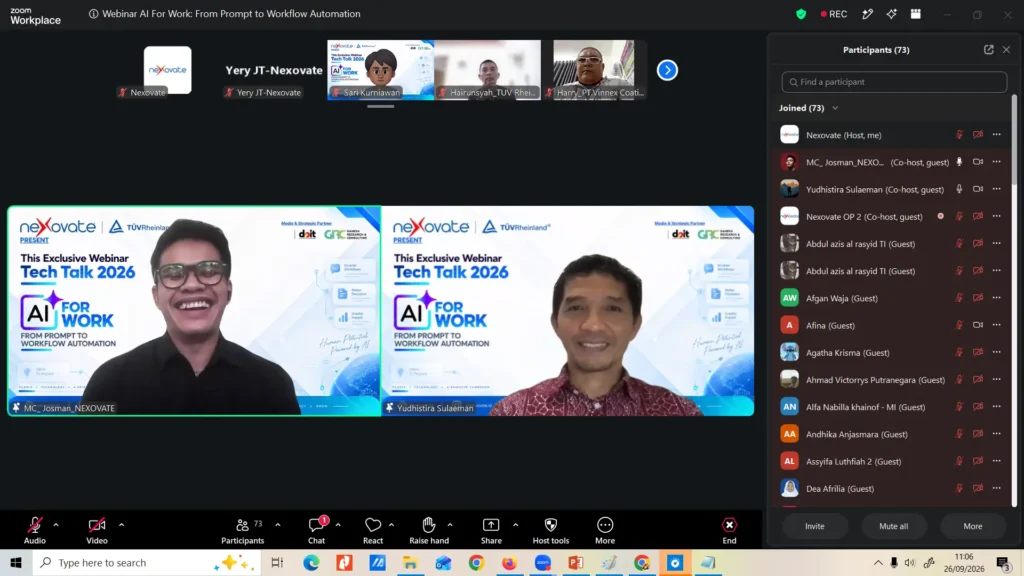
The use of Artificial Intelligence (AI) in the workplace continues to evolve. However, effectively utilizing AI requires more than just the ability to craft good prompts; professionals also need to understand how to integrate AI into their workflows to boost productivity, streamline processes, and generate higher-quality output.
To address this need, Nexovate is hosting the "AI for Work: From Prompt to Workflow" webinar on Saturday, September 26, 2026. This free, 90-minute online event features Yudhistira Sulaeman as the speaker, focusing on transforming AI usage from isolated instructions into structured, efficient workflows that remain under human oversight.
This program is designed for cross-sector professionals—including staff, analysts, specialists, administrators, and university faculty and professional staff—who wish to understand the use of AI more systematically without requiring a programming background.
One of the key takeaways from this webinar is the importance of understanding workflows before deciding on the technology to be used. AI serves not merely as a tool for answering questions, drafting documents, or summarizing information, but can also support a series of interconnected professional activities.
Through a "workflow thinking" approach, participants are introduced to the distinctions between tasks, processes, and workflows, including how each job involves inputs, processes, decision points, outputs, and the movement of work between stages.
This understanding serves as the basis for identifying repetitive activities, process bottlenecks, and opportunities to improve efficiency through AI assistance.
Examples of its application range from document processing, the preparation of management reports, and following up on meeting outcomes to information monitoring and administrative tasks within an academic setting.
This webinar also introduces a framework for identifying work components that can be simplified, AI-assisted, or automated, versus those that still require human oversight. The framework emphasizes that effective AI implementation does not necessarily mean automating entire activities. Organizations must first evaluate existing processes, determine actual needs, and ensure that the use of technology delivers relevant benefits. In this way, AI is positioned as part of a solution to enhance workflow quality, rather than merely an add-on technology.
One of the key components of the webinar agenda is a demonstration showcasing the evolution of AI usage—moving from a single prompt to a multi-stage workflow
Participants are guided to understand how simple interactions with AI can evolve into processes involving information processing, summarization, classification, and drafting, all the way to the automation of specific activities.
This demonstration employs a visual and non-technical approach, allowing the concept of workflow automation to be understood without the need to learn coding or master a specific automation platform.
Furthermore, the discussion covers the differences between AI Assistants, workflow automation, and AI Agents. These three differ in terms of characteristics, levels of autonomy, integration requirements, and oversight mechanisms.
Based on this understanding, participants are encouraged to recognize that the use of AI agents is not always necessary for every business process. Selecting a solution requires considering the complexity of the task, expected benefits, and operational risks.
Amid the growth of automation technology, the human role remains a crucial component in the implementation of AI within professional environments.
Through the "human-in-the-loop" concept, this webinar emphasizes the need to maintain mechanisms for verification, approval, the handling of special cases, and decision-making at stages of work that require human judgment.
The use of AI requires proportionate oversight, particularly when the technology is employed to support information processing, report preparation, or processes with consequences for the organization.
This principle aligns with the approach of using AI responsibly: leveraging the technology's capabilities to assist with tasks while ensuring the quality of outcomes and accountability for final decisions.
To conclude, the program features a "Map Your AI Workflow Opportunity" reflection exercise, inviting participants to map out a specific workflow with the potential for AI-driven improvement. Through this exercise, participants are guided to identify key bottlenecks, determine opportunities for AI integration, and recognize stages that still require human oversight. This approach serves as a starting point for cultivating a more systematic mindset regarding AI usage, while helping professionals bridge their understanding of the technology with the practical needs of their respective work environments.
Through *AI for Work: From Prompt to Workflow*, Nexovate emphasizes the importance of developing AI competencies that go beyond mere tool mastery to encompass systematic thinking, process understanding, and the ability to identify opportunities for work improvement. This approach enables professionals and organizations to advance their AI adoption, progressing from routine daily use to the development of more integrated workflow automation. As part of its commitment to professional capability building and digital transformation, Nexovate continues to champion learning that is relevant, contextual, and aligned with the needs of the modern workplace.
Looking to develop AI and workflow automation capabilities within your organization? Visit nexovate.id to learn more about Nexovate's training programs and capability development solutions.
0822 6140 9779
admin@nexovate.id
©2025. Nexovate. All Rights Reserved.